Public study · UAE / GCC · 2026
The Addressable and the Invisible
The Machinery Is Visible. The Decision Is Not.
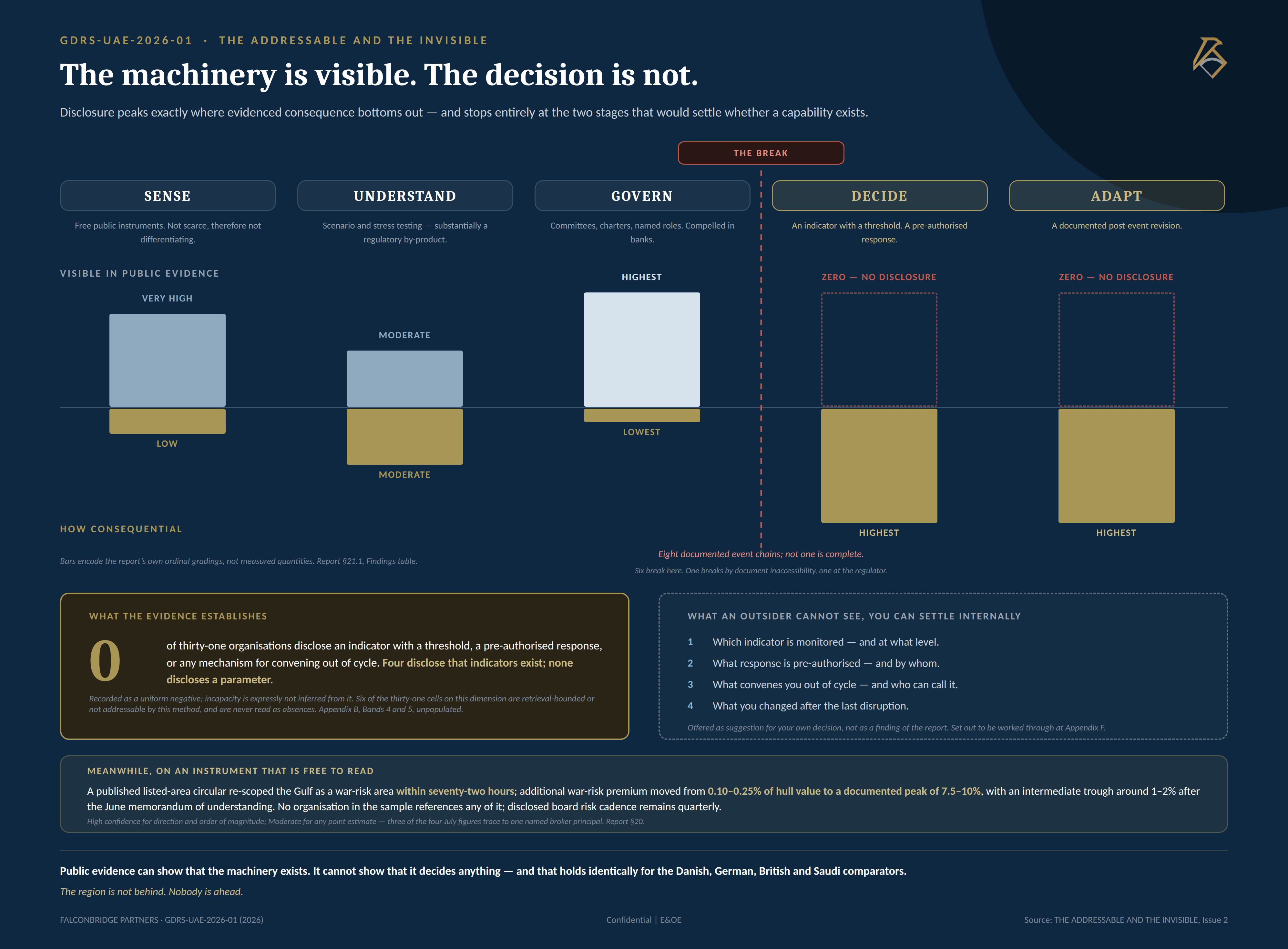
The study asked how leading UAE and GCC companies institutionalise geopolitical and operational risk intelligence, and what constitutes emerging best practice. The conflict that began on 28 February 2026 — with no ceasefire verified in force at the evidence cut-off — supplied the test. Thirty-one organisations across four jurisdictions were read against the public record: annual and governance reports, regulatory instruments and the insurance market's own circulars. Across all thirty-one — four jurisdictions, three disclosure regimes — not one disclosed an early-warning indicator with a threshold, a pre-authorised response, or any mechanism for convening out of cycle. Four disclose that indicators exist; none discloses a parameter. A uniform negative on this scale is more consistent with a disclosure convention than with a uniform absence of capability, and the report records the absence while expressly declining to infer the incapacity. That result reorganises the question. The stage of the chain that generates the most disclosure — committees, charters, named roles — has the weakest evidenced link to any outcome: the one available test — a working paper, on banks — finds that establishing a board risk committee does not reduce a bank's risk on average, and across eight documented event chains from the 2026 conflict, disclosed machinery did not predict response quality. The two stages that would settle whether a capability exists — the threshold that fires, and the review that follows an event — produce no disclosure at all. Observability and consequence run in opposite directions. One external instrument keeps a different clock. A published listed-area circular re-scoped the Gulf as a war-risk area within seventy-two hours of the conflict beginning, and additional war-risk premium moved from 0.10–0.25% of hull value to a documented peak of 7.5–10%, with an intermediate trough around 1–2% after the June memorandum of understanding; annual Gulf cover ceased entirely, and the market went voyage-by-voyage on quotes valid twenty-four to forty-eight hours. The circulars are free to read. No organisation in the sample references any of them, and disclosed board risk cadence remains quarterly. Two findings keep the picture honest. Structure follows compulsion rather than exposure — the most Red-Sea-exposed listed company in the world places risk with its audit committee — so a risk committee in a Gulf bank and none in a Gulf corporate is a regulatory artefact carrying no information about relative capability. Compulsion explains the uniformity of the structure, not every instance: two GCC telecommunications groups adopted standalone risk committees voluntarily. And the strongest interpretive statement located anywhere in the study came from an organisation with no disclosed board risk committee and no chief risk officer, in a voluntary publication. On public evidence these organisations have built the addressability; whether they have built the conversion cannot be determined, and that holds identically for the Danish, German, British and Saudi comparators. The region is not behind. Nobody is ahead. The reading FalconBridge would offer is that the comparative question is the wrong one to spend money on, because no public-evidence benchmark — including this report's own — can reach the part that decides anything. The four questions an outsider cannot answer are answerable internally in a single session: which indicator is monitored and at what level, what response is pre-authorised and by whom, what convenes the organisation out of cycle, and what was changed after the last disruption. Appendix F sets them out to be worked through. The external market instruments cost nothing and move faster than any governance cycle. Findings and figures above are the report's own and carry its confidence markings there. The eight event chains are capped at Moderate because no primary exchange filing was retrieved directly, as are the decoupling of architecture from content and the state-support finding; the war-risk premium is High for direction and order of magnitude but Moderate for any point estimate, and three of its four July figures trace to one named broker principal. Six of the thirty-one cells on the indicator dimension are retrieval-bounded or not addressable by this method, and are never read as absences. Bank outcome data is excluded from capability assessment throughout, because the regulator had authorised loan-classification postponement. The final paragraph is FalconBridge's judgement about what to do with these findings, offered as suggestion for the reader's own decision, not as a conclusion of the report.
31 organisations
Across all thirty-one — four jurisdictions, three disclosure regimes — not one disclosed an early-warning indicator with a threshold, a pre-authorised response, or any mechanism for convening out of cycle.
72 hours
A published listed-area circular re-scoped the Gulf as a war-risk area within seventy-two hours of the conflict beginning
Nobody is ahead
The region is not behind. Nobody is ahead.
UAE / GCC · Week 33, 2026
The complete package
Five elements, tailored to the question and to how readers will use the work
Tell us who is reading and the pack is emailed to you straight away. The package is released under a Type-1 licence for the requester’s own use. Public access does not transfer ownership.

A conversation about your decision
What needs to be understood
before your next decision?
Bring the proposition, question or direction you are working on. Together, we can define the support it requires.
Start a conversation