Public study · USA · 2026
Stranded Private Capital
Early-Warning Signals in North America
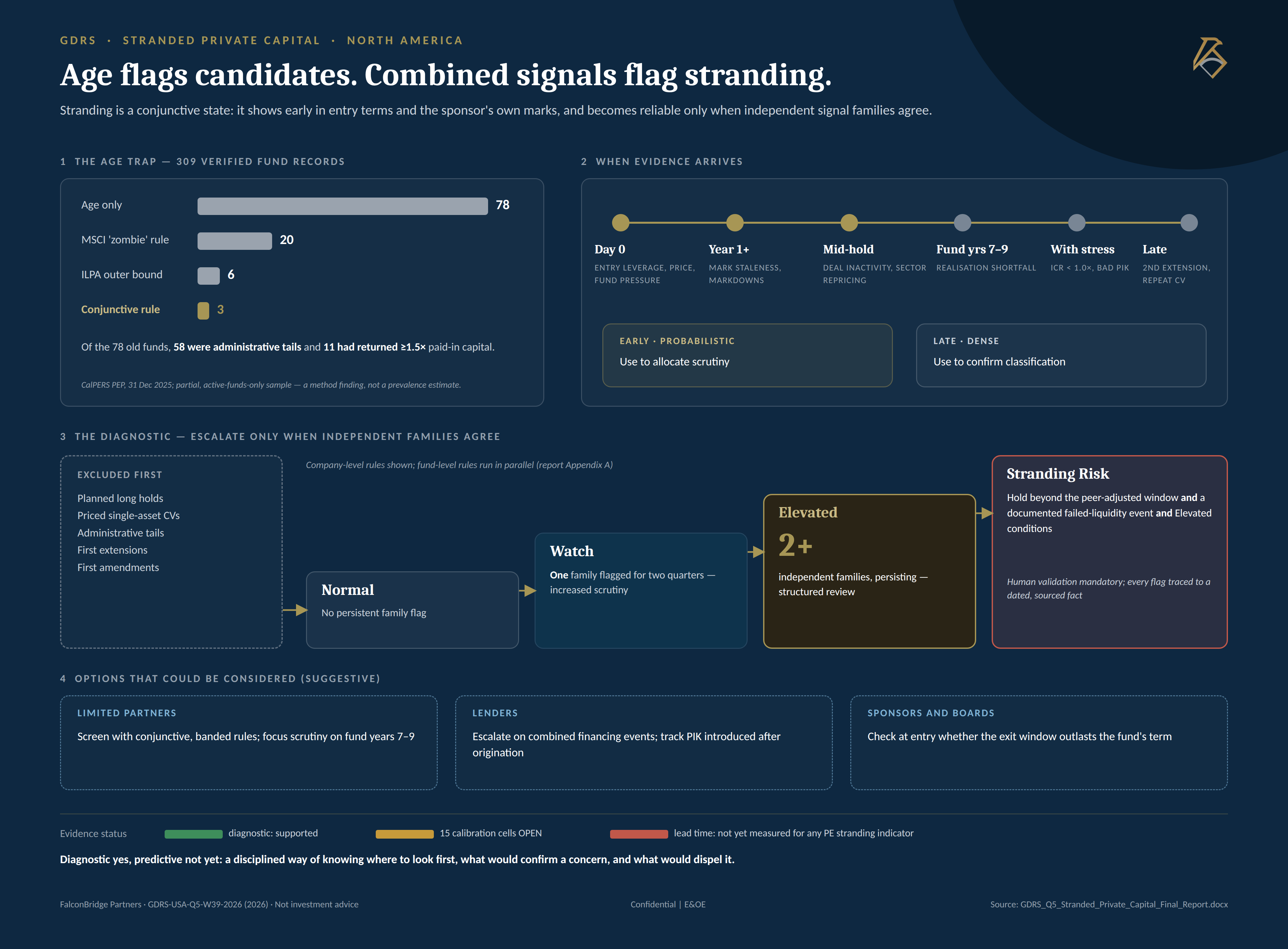
Bain & Company counts 32,000 unsold private-equity-backed companies worth about $3.8 trillion, and PitchBook data put US private-equity NAV in funds at least a decade old at a record $348.5 billion at the end of 2025. Aggregates like these invite the conclusion that private capital is stranded, but no investor, lender or sponsor acts on an aggregate. The study therefore asked which observable characteristics most reliably show that a particular company or fund is becoming stranded, and whether they can be seen before the conventional exit window closes. Age is not stranding. Of 309 verified CalPERS fund records, an age-only rule flagged 78 funds. Fifty-eight of them were administrative tails and eleven had already returned at least 1.5 times paid-in capital. A conjunctive rule combining age, residual value and realisation progress retained three, about one twenty-sixth as many. The sample is partial and non-random, so this is a finding about method, not about prevalence. The earliest warnings are visible on the day of purchase and in the sponsor's own valuations. Above-median entry leverage, peak pricing and deployment under pressure are associated with later distress and weaker returns. Stale marks and frequent markdowns are, in a working paper verified at abstract level, informative from the first year of the investment. The financing layer holds the most signals but also disguises distress: PIK interest introduced after origination affects about 5.9% of loans in one valuation dataset, and distressed exchanges made up 64% of defaults in the first half of 2025. A first amendment or a single continuation vehicle says little. Repeated and combined events across independent signal families say a great deal. Several popular inferences fail. Research finds no evidence that continuation vehicles disproportionately hold weaker assets. Once leverage is accounted for, the evidence locates default risk in the capital structure chosen at entry, not in sponsor ownership itself. Public filings can support a monitor at fund and lender level, but not a view of sponsors' portfolio companies, whose marks, accounts and failed sale processes are not disclosed. The answer is diagnostic yes, predictive not yet. No study has measured the lead time or discrimination of any private-equity stranding indicator, so the study offers a transparent four-tier diagnostic rather than a score. Fifteen calibration cells remain open pending licensed data or practitioner validation. The report does not estimate how much capital is stranded. It records eleven forms of evidence decay, three of which affect the signals and outcomes themselves. Limited partners could consider screening with conjunctive, banded rules rather than age, and concentrating scrutiny on fund years seven to nine. Lenders could treat combined financing events, not first amendments, as the trigger for escalation. Sponsors and boards could check at entry whether an investment's normal exit window outlasts its fund's term. Refusing extensions as a matter of policy, or buying a packaged distress score, is not supported by the evidence. Figures and findings above are drawn from the source report, where each is verified against a fetched source and carries its confidence marking. The options in the final paragraph are offered as suggestions for the reader's own decision, not directions, and are not investment advice. No company, fund or manager is named as stranded. E&OE. All rights reserved.
78 to 3
A conjunctive rule combining age, residual value and realisation progress retained three, about one twenty-sixth as many.
64%
distressed exchanges made up 64% of defaults in the first half of 2025
Years seven to nine
Limited partners could consider screening with conjunctive, banded rules rather than age, and concentrating scrutiny on fund years seven to nine.
The complete package
Six elements, tailored to the question and to how readers will use the work
Tell us who is reading and the pack is emailed to you straight away. The package is released under a Type-1 licence for the requester’s own use. Public access does not transfer ownership.

A conversation about your decision
What needs to be understood
before your next decision?
Bring the proposition, question or direction you are working on. Together, we can define the support it requires.
Start a conversation