Public study · Mauritius · 2026
Higher For Longer Cost Base
Mauritius: the next cost increase is already fixed, not forecast
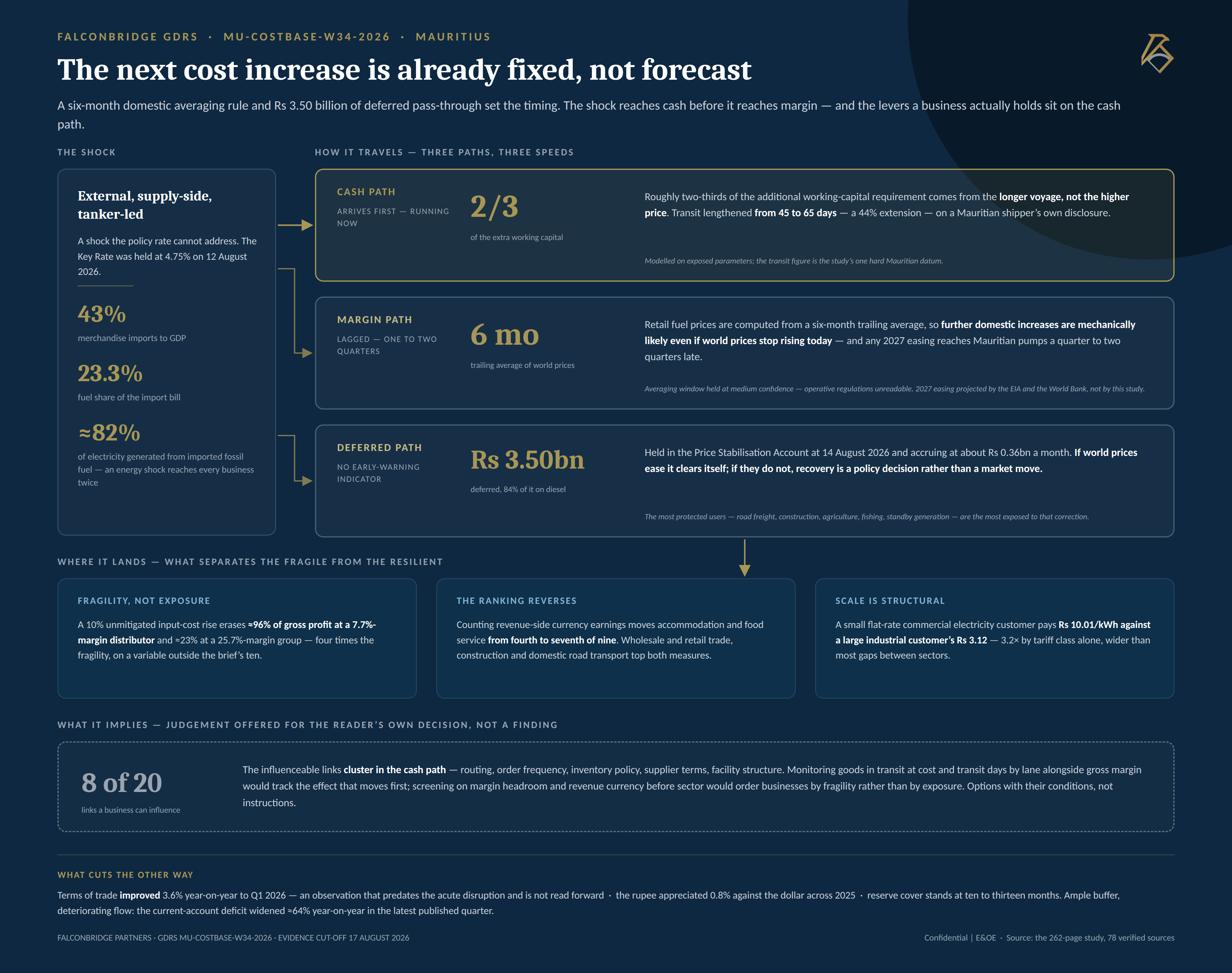
The Bank of Mauritius held its Key Rate at 4.75 per cent on 12 August 2026. This study asked whether a stable policy rate implies a stable cost base for Mauritian businesses over the next twelve to twenty-four months. It does not, and the gap is more structured and more predictable than the question anticipated: merchandise imports run at roughly 43 per cent of GDP, fuel is 23.3 per cent of the import bill, and about 82 per cent of electricity is generated from imported fossil fuel, so an energy shock reaches every business twice. The anchor fact is a timing one. A Mauritian shipper's own disclosure records transit lengthening from 45 to 65 days; on the study's parameterised model, roughly two-thirds of the additional working-capital requirement comes from the longer voyage rather than the higher price. A twenty-day extension costs about twice as much working capital as a ten per cent price rise. The cash effect therefore leads the profit effect, which is how a business can report cash pressure alongside stable margins. The model is explicitly modelled, with every parameter exposed for substitution. Two mechanisms fix what happens next. Domestic retail fuel prices are computed from a six-month trailing average of world prices, so further increases are mechanically likely even if world prices stop rising today, and the 2027 easing that the US Energy Information Administration and the World Bank both project would reach Mauritian pumps one to two quarters late — a forecast attributed to those bodies, not a study projection, and the averaging window is held at medium confidence because the operative regulations could not be read. Separately, Rs 3.50 billion of pass-through sits deferred in the Price Stabilisation Account at 14 August 2026, 84 per cent of it on diesel, accumulating at roughly Rs 0.36 billion a month: if world prices ease the claim clears itself, and if they do not, recovery becomes a policy decision rather than a market move. Three findings cut the other way and are carried at full weight. The terms of trade improved — up 3.6 per cent year-on-year to Q1 2026, an observation that predates the acute disruption and must not be read forward. The currency channel is the quietest of the three, the rupee having appreciated 0.8 per cent against the dollar across 2025. And the external buffer is strong at ten to thirteen months of import cover. The correct reading is ample buffer with a deteriorating flow: the current account deficit widened about 64 per cent year-on-year in the latest published quarter. What the study cannot establish is stated rather than inferred: freight costs actually paid in Mauritius (that review is marked low confidence throughout), what a Mauritian company pays to borrow, the imported share of any firm's cost of goods, sector import intensity in the absence of a national input–output table, and inflation expectations, which nobody has measured since 2019. No probability is attached to the adverse scenario, six of nine supplier-concentration cells are left open rather than filled by analogy, and a composite vulnerability index was declined on the brief's own governance grounds. On that evidence, three shifts appear worth considering. Monitoring goods in transit at cost and transit days by lane, alongside gross margin, would track the effect that moves first. Screening on margin headroom and revenue currency composition before sector would order businesses by fragility rather than by exposure — on published structures a 10 per cent unmitigated input-cost rise erases about 96 per cent of gross profit at a 7.7 per cent-margin distributor against 23 per cent at a 25.7 per cent-margin group. And of twenty links between shock and outcome, the eight a business can influence cluster in the cash path, which is where mitigation effort would repay most. Figures and findings above are drawn from the source report, where each is dated, sourced and carries its own confidence marking; modelled results are identified as modelled and forecasts are attributed to the bodies that made them. The final paragraph is judgement about what the findings imply, offered for the reader's own decision rather than as instruction.
45 to 65 days
A Mauritian shipper's own disclosure records transit lengthening from 45 to 65 days
Rs 3.50 billion
Rs 3.50 billion of pass-through sits deferred in the Price Stabilisation Account at 14 August 2026, 84 per cent of it on diesel, accumulating at roughly Rs 0.36 billion a month
Twice
A twenty-day extension costs about twice as much working capital as a ten per cent price rise.
Mauritius · Week 34, 2026
The complete package
Five elements, tailored to the question and to how readers will use the work
Tell us who is reading and the pack is emailed to you straight away. The package is released under a Type-1 licence for the requester’s own use. Public access does not transfer ownership.

A conversation about your decision
What needs to be understood
before your next decision?
Bring the proposition, question or direction you are working on. Together, we can define the support it requires.
Start a conversation