Public study · UAE / GCC · 2026
Hidden Geographic Concentration Risk in the UAE Economy
Every Instrument Read Fine. The Reality Moved the Other Way.
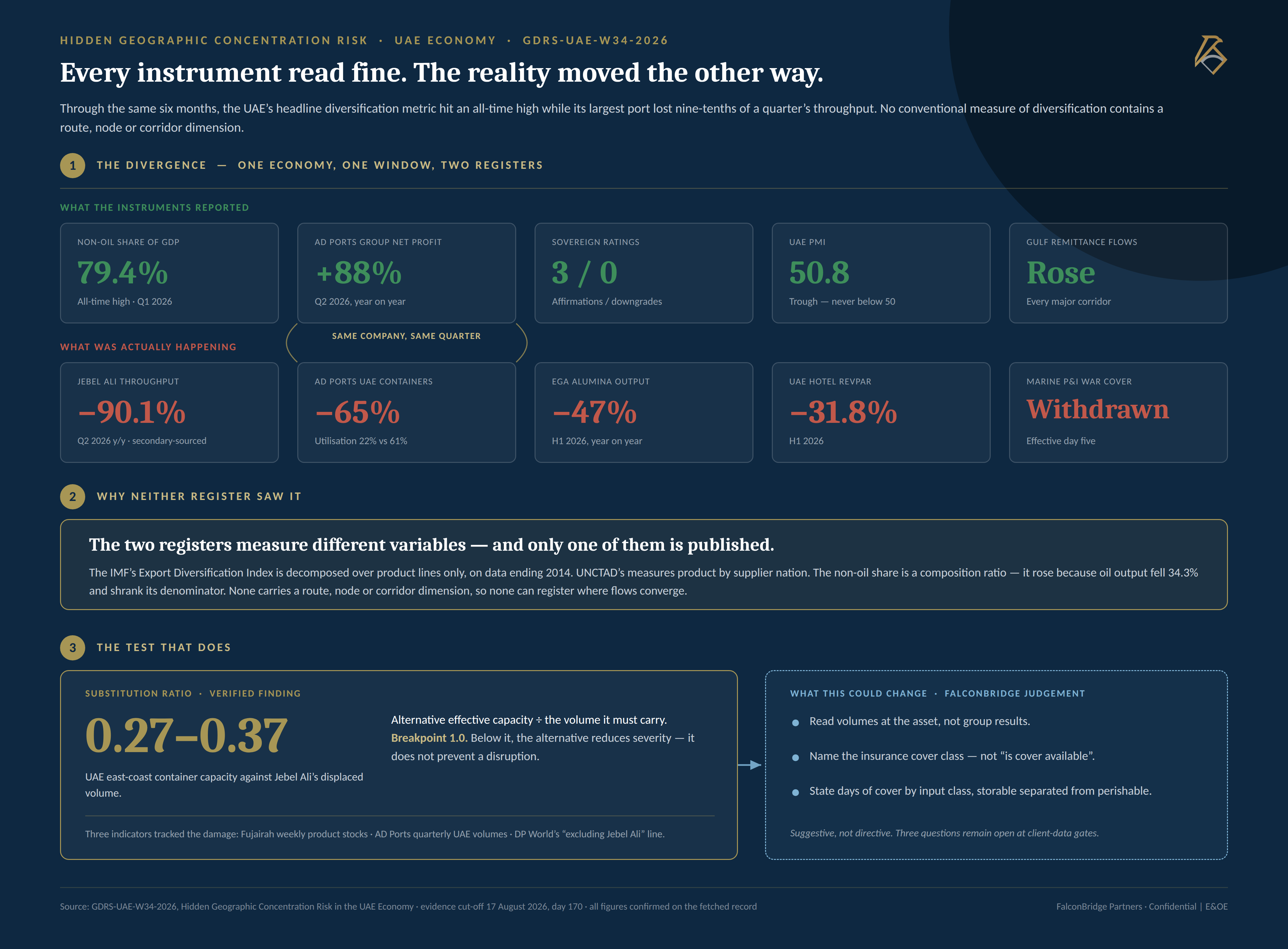
The study set out to find where the UAE’s nominally diversified sectors converge on the same routes, nodes and infrastructure. It found the convergences — and, first, it found that the instruments a decision-maker would use to detect them cannot. No conventional measure of economic diversification contains a route, node or corridor dimension: the IMF’s Export Diversification Index is decomposed over product lines only, on data ending in 2014; UNCTAD’s measures product by supplier nation; the non-oil share of GDP is a ratio of sectoral composition. Each was examined at source. The consequence is measurable rather than argued. In the quarter containing the closure of the Strait of Hormuz, the UAE’s non-oil share of GDP rose to an all-time high of 79.4% — because oil production fell 34.3% year on year in March and collapsed the ratio’s denominator. Over the same window the Purchasing Managers’ Index never fell below 50, three rating agencies affirmed the UAE without a downgrade, and remittance flows rose across every major corridor. Beneath them, the physical record moved the other way. Jebel Ali’s container throughput fell 59.5% over the first half and approximately 90.1% in the second quarter — a figure stated nowhere, recoverable only by subtracting two lines DP World was obliged to disclose. AD Ports’ UAE container volumes fell 65%; Emirates Global Aluminium’s alumina output fell 47%; marine protection-and-indemnity war cover was withdrawn on day five, making lawful port calls impossible regardless of hull cover. The economy did not split by sector. It split by exposure to physical flow. The counterweight is real and reported at the same weight. The Habshan–Fujairah pipeline lifted Fujairah’s share of UAE crude exports from 51% to 66% between June and July 2026 — optionality no Gulf state but Saudi Arabia possesses. The food price-control architecture that absorbed staple inflation predates the war by fourteen months, and the banking system absorbed rather than transmitted the shock. Three questions remain open at client-data gates — insurance placement by cover class, days of cover by input class, workforce composition — because that information is commercially confidential and does not exist in public form; six further gaps remain open for resource rather than evidential reasons. Conditions are stated as at 17 August 2026, day 170, and are explicitly perishable. A reader could consider treating a strong diversification score as a null result on route concentration rather than as reassurance; reading physical volumes at the asset rather than group results, which here moved opposite to operations at three companies in three sectors; naming the insurance cover class rather than asking whether cover is available; and computing, for any alternative a proposition relies on, its effective capacity against the volume it must carry. On the UAE east coast that ratio is 0.27–0.37 against Jebel Ali’s displaced volume — and doing so could conceivably surface, before commitment, convergence no diversification score can show. Figures above are findings of the source report, each confirmed on a live-fetched page and reproduced without rounding or amendment; qualifiers and open-gate notations survive unchanged. The closing paragraph is FalconBridge’s judgement about what those findings could mean for a reader’s own decision — offered as suggestion, not as the report’s conclusion.
79.4%
the UAE’s non-oil share of GDP rose to an all-time high of 79.4% — because oil production fell 34.3% year on year in March and collapsed the ratio’s denominator
59.5%
Jebel Ali’s container throughput fell 59.5% over the first half and approximately 90.1% in the second quarter
51% to 66%
The Habshan–Fujairah pipeline lifted Fujairah’s share of UAE crude exports from 51% to 66% between June and July 2026
UAE / GCC · Week 34, 2026
The complete package
Five elements, tailored to the question and to how readers will use the work
Tell us who is reading and the pack is emailed to you straight away. The package is released under a Type-1 licence for the requester’s own use. Public access does not transfer ownership.

A conversation about your decision
What needs to be understood
before your next decision?
Bring the proposition, question or direction you are working on. Together, we can define the support it requires.
Start a conversation