Public study · North Carolina · 2026
FutureTEX Ecosystem Study
The ecosystem was not forming. It was already running.
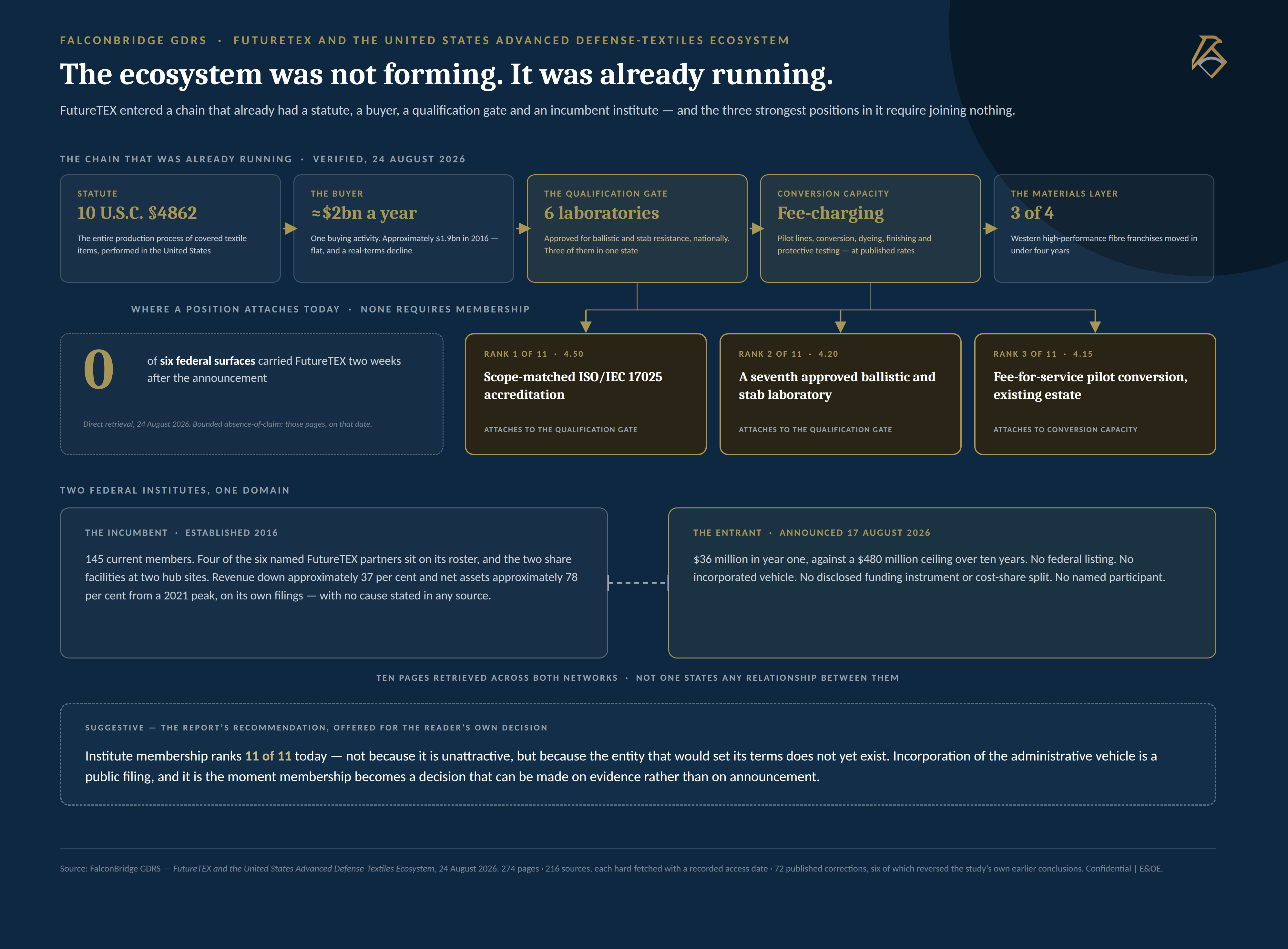
North Carolina State University announced on 17 August 2026 that it would lead FutureTEX, a ten-year initiative to modernise United States textile manufacturing for defense applications, carrying $36 million in its first year against a ceiling of $480 million over a decade. This study was commissioned to establish who would matter within the resulting ecosystem, why, how they would connect, and where the highest-value partnership opportunities would lie. It was expressly instructed to resist producing a celebratory economic-development narrative. Two weeks after the announcement, FutureTEX appeared on none of six federal surfaces checked by direct retrieval — neither the coordinating institute roster nor any surface of its own sponsoring department. Its classification rests on a single trade publication; its funding instrument and federal cost-share split are disclosed nowhere; and its administrative vehicle is stated as an objective rather than an entity, with no incorporation filing locatable in any open source. The absence is probably administrative rather than substantive, since network annual reporting runs roughly thirty months behind the period it covers. But cause does not change consequence: there is no federal record against which a reader can currently check anything about this programme. What the record does establish is that the ecosystem itself is not forming. It already exists — as a statute requiring the entire production process of covered textile items to be performed domestically, a protected procurement channel of approximately $2 billion a year administered by a single buying activity, a qualification regime in which laboratory authorisation is granted contract by contract, a materials layer whose ownership moved three times in four years, and an incumbent federal institute for fibres and fabrics established in 2016 with 145 current members, four of whom are also FutureTEX partners. Value concentrates at that gate rather than at the table: of eleven partnership archetypes assessed, the three strongest are scope-matched laboratory accreditation, ballistic-testing capacity, and fee-for-service pilot conversion using the existing North Carolina estate. None requires joining the programme. North Carolina's position is genuine and specific. The state holds the middle of the chain more completely than any other hub, much of it fee-charging and available without membership, and it holds more of the upstream than this study first concluded — a correction the study made against itself and published rather than absorbed. It does not hold the procurement gate, the scarce certification capacity, classified evaluation, or, on any evidence located, capital. Two federal institutes now occupy the same technology domain, sharing facilities at two hub sites and four of six named partners. Ten pages were retrieved across both networks and not one states any relationship between them — not succession, not complementarity, not overlap, not distinctness. No inference is drawn about either institute's agreement status or about intent behind the silence. Alongside ten named unknowns and four gates requiring a person rather than a tool, this is the single most consequential item the study could not close. A reader could conceivably build position in the chain now, at a cost measured in tens of thousands rather than millions, put five specific questions to the programme directly, and treat incorporation of the administrative vehicle — a public filing — as the moment institute membership becomes a decision that can be made on evidence rather than on announcement. Membership currently ranks last of the eleven archetypes, not because it is unattractive but because the entity that would set its terms does not yet exist. Findings and figures above are drawn from the source report, where each rests on a live retrieval confirming that claim on the page and carries a recorded access date. The closing paragraph is suggestive rather than directive: it describes positions a reader could consider, with the decision remaining theirs.
$480 million
carrying $36 million in its first year against a ceiling of $480 million over a decade
None of six
Two weeks after the announcement, FutureTEX appeared on none of six federal surfaces checked by direct retrieval
$2 billion a year
a protected procurement channel of approximately $2 billion a year administered by a single buying activity
North Carolina · Week 35, 2026
The complete package
Five elements, tailored to the question and to how readers will use the work
Tell us who is reading and the pack is emailed to you straight away. The package is released under a Type-1 licence for the requester’s own use. Public access does not transfer ownership.

A conversation about your decision
What needs to be understood
before your next decision?
Bring the proposition, question or direction you are working on. Together, we can define the support it requires.
Start a conversation