Public study · South Africa · 2026
Cause versus Signal
What the SPAR board resignations actually repriced
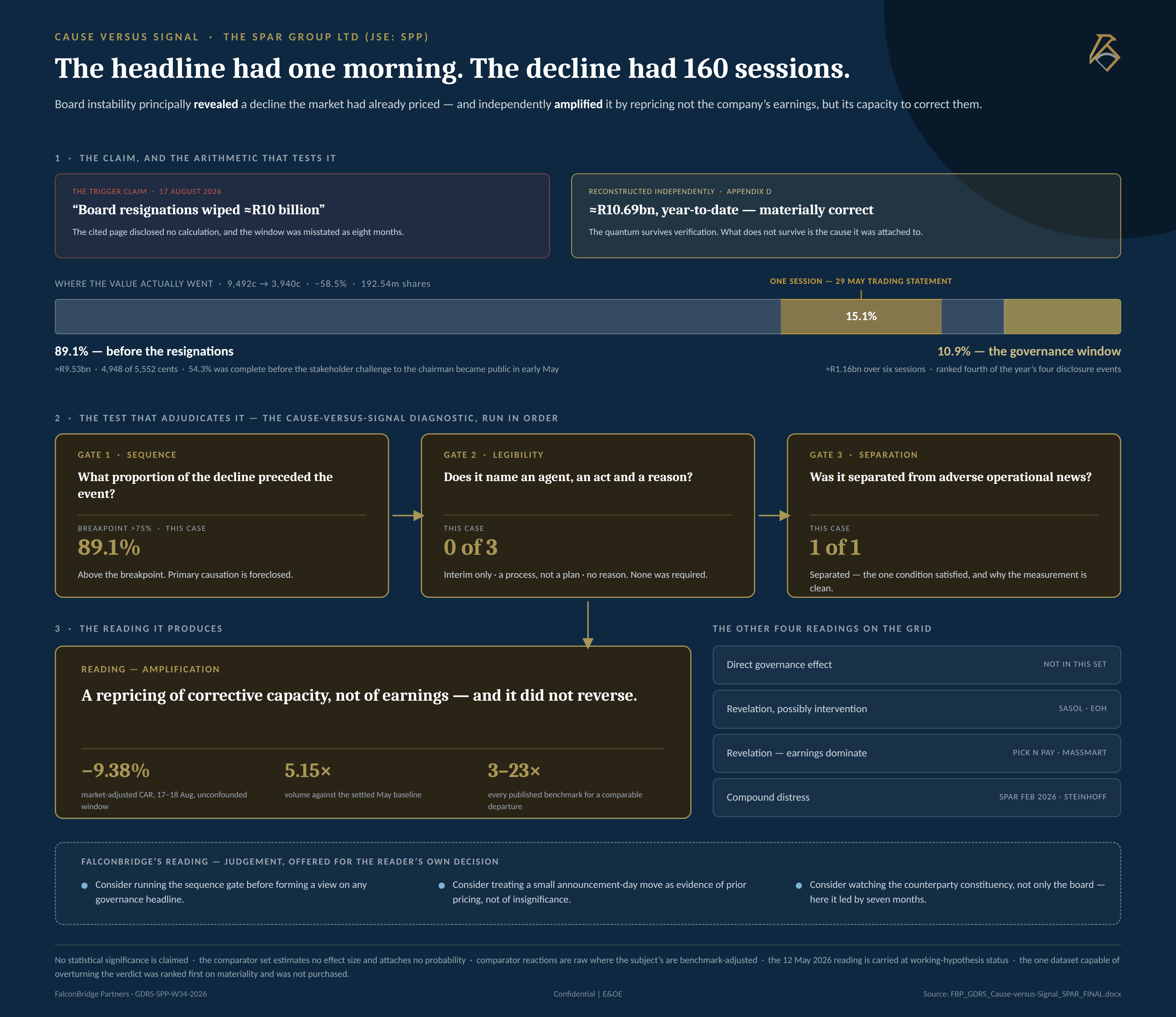
The study was commissioned off a weekly market-scan item reporting that board resignations at The SPAR Group Ltd (JSE: SPP) had wiped roughly R10 billion, with an instruction to test that reading rather than support it. It asks whether board instability destroys shareholder value or principally reveals problems the market has already begun pricing, and adjudicates four competing hypotheses against dated regulatory disclosures, benchmark-adjusted market data and twelve comparator cases drawn from the same exchange. Of the 58.5 per cent by which the share fell between 2 January and 24 August 2026 — approximately R10.69 billion on 192.54 million shares — 89.1 per cent occurred before the resignations were announced. A single operational trading statement on 29 May destroyed 15.1 per cent of the year's value in one session, against 10.9 per cent across the whole six-session governance window. On 10 June the company itself attributed 80.6 per cent of a 45.3 per cent operating-profit collapse to three named execution factors, and none of it to governance — ten weeks before its chairman resigned. The event was nonetheless not nothing. Against a specification fixed before any outcome was computed, 17 August produced a market-adjusted cumulative abnormal return of −9.38 per cent over an unconfounded two-session window, on more than five times normal volume and without reversal — between three and twenty-three times every published benchmark for a comparable departure. What it repriced was corrective capacity, not earnings: the June results confirming that collapse had moved the share up 1.16 per cent. The announcement named an interim successor, no corrective act and no reason, in a regime that compels the fact of a departure and not its cause. Across twelve JSE cases assembled under rules fixed before any outcome was examined, every positive reaction was board-initiated, named a permanent successor simultaneously, and was separated from adverse operational disclosure; every negative reaction lacked at least one. Reactions ran from approximately −60 per cent to +22 per cent, and two companies that appointed named, permanent, credible chief executives still fell twelve to fifteen per cent because a profit warning landed in the same announcement. No statistical significance is claimed: a single-firm event study with a fifteen-observation estimation window and no credible beta cannot deliver conventional inference. The comparator set is small and non-random, estimates no effect size, and its reactions are raw where the subject's are benchmark-adjusted. The May 2026 finding that the board's declaration of confidence was priced worse than the challenge itself is carried at working-hypothesis status. One purchasable dataset — analyst consensus and target-price revisions through 2026 — could weaken the central reading; it was ranked first on materiality and was not purchased. Decision-makers could consider running the sequence test before forming a view on any governance headline. Boards could weigh whether an interim appointment after a foreseeable departure forfeits the mitigation the evidence otherwise allows, and whether announcing adjacent to adverse trading news serves them. Diligence teams could consider adding the counterparty constituency to the governance workstream: here counterparty litigation was publicly reported seven months ahead and a formal removal petition three months ahead, both at no cost. Figures and findings above are drawn from the source report, where each is traced to a dated primary source. The considerations in the final paragraph are offered for the reader's own judgement rather than as directives, and no finding is asserted about the conduct, competence or culpability of any individual.
89.1%
89.1 per cent occurred before the resignations were announced
−9.38%
17 August produced a market-adjusted cumulative abnormal return of −9.38 per cent over an unconfounded two-session window, on more than five times normal volume and without reversal
Twelve cases
every positive reaction was board-initiated, named a permanent successor simultaneously, and was separated from adverse operational disclosure; every negative reaction lacked at least one
South Africa · Week 35, 2026
The complete package
Five elements, tailored to the question and to how readers will use the work
Tell us who is reading and the pack is emailed to you straight away. The package is released under a Type-1 licence for the requester’s own use. Public access does not transfer ownership.

A conversation about your decision
What needs to be understood
before your next decision?
Bring the proposition, question or direction you are working on. Together, we can define the support it requires.
Start a conversation